


Weather - By Xiaomi
Xiaomi Inc.
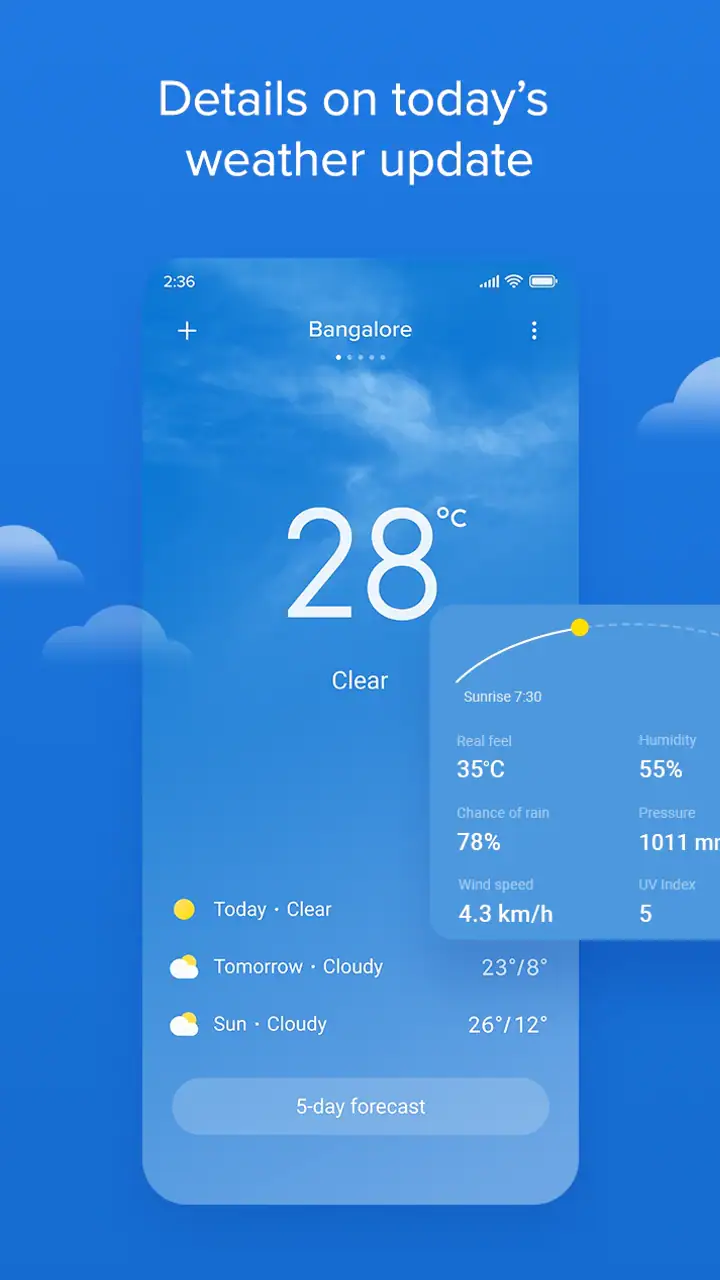
Weather is one of those apps I open without thinking, usually while I am putting on shoes, planning a trip across town, or deciding whether laundry can stay outside. Xiaomi’s weather app takes that simple habit and keeps it focused: current conditions, a forecast for my city, temperature, and air-quality information in one place. It is a free weather app from Xiaomi Inc., rated for Everyone, and it runs on Android 7.0 or later.
After spending time with it, I see the main appeal clearly. This is not trying to be a full meteorological workstation. It is a quick daily reference that works best when I want an answer in a few seconds. Its large user base—over one billion installs and an average rating of 4.1 from around 1.3 million ratings—also suggests that its straightforward approach fits a lot of people. Still, the experience depends heavily on a working connection, and that matters more than the clean interface may suggest.
What it feels like in everyday use
The first thing I appreciate is the low effort involved. I do not need to dig through menus to find the temperature or the basic outlook. For a morning check, the app gives me the information I am most likely to need before leaving home. That makes it especially comfortable for routine decisions rather than detailed planning.
Related News

How OTR - Offroad Car Driving Game Builds Community Through Shared Driving Stories

Why PK XD Keeps Players Coming Back Through Small Social Rituals
A realistic example is a short commute. I check the app before walking to a station, notice that the forecast looks unsettled, and decide to carry a compact umbrella. Later, before heading home, I look again because the conditions may have changed. That second check is where a connected weather app earns its place: the value is not only in showing a forecast, but in letting me refresh my decision close to the moment I need it.
The city focus is useful for people who want a local snapshot instead of a long list of locations. If your routine revolves around one home area, the app feels appropriately direct. Travelers and people who regularly move between cities may find the experience less satisfying if they expect a richer multi-location dashboard, detailed maps, or an extensive set of specialist tools.
Related News

Instagram Is No Longer a Photo App. It Is an Attention Engine

Microsoft Teams Mobile: When Collaboration Becomes Navigation

How the NFL App Adapts to Android and iOS Updates

Temu: Elevate Your Shopping Experience to Billionaire Status

Why Traffic Rider Works Best as a Precision Reflex Game

How Google’s Find Hub Transforms Everyday Searches
I would describe the visual style as practical rather than expressive. It is designed to be read quickly, not explored for entertainment. That is a strength when I am in a hurry, although users who enjoy animated radar views, deep charts, or highly customizable weather layouts may prefer a more specialized alternative.
Why the connection matters more than it first appears
The app’s most useful moments are tied to current information. Temperature, forecasts, and air-quality readings are only valuable when they reflect the place and time I care about. A weak or unavailable connection can turn a quick glance into an incomplete check, particularly when I am outside, underground, traveling, or moving through an area with unreliable mobile coverage.
That creates an important distinction between opening the app and receiving genuinely fresh information. The interface may still be familiar when I launch it, but I should not treat a displayed condition as a guarantee that it has just been updated. My practical habit is to open it while I still have a stable connection, especially before leaving for a long journey or an outdoor activity.
Gallery
This is also why I would not choose it as my only preparation tool for situations where changing weather has serious consequences. For a normal walk, commute, school run, or shopping trip, it is convenient. For a mountain outing, a long drive, or work that depends on precise weather timing, I would want a more specialized source and a second way to check conditions.
Using it on a phone, not at a desk
The app makes most sense on a phone because weather decisions are often made in transition. I use it at the doorway, beside a bus stop, or just before leaving a building. The short interaction suits that context better than a desktop-style weather service filled with panels and technical details.
There is a trade-off, though. A compact mobile experience can hide the complexity of changing conditions. A simple forecast is easy to understand, but it may not answer every question about a day outdoors. If I need to compare several time periods, inspect a wider region, or understand how conditions may develop along a route, I would rather use a service built around those tasks.
For families, the app can be useful as a shared routine: check the city before school, work, or errands, then make a small practical adjustment. The air-quality information adds another reason to look beyond temperature. Someone planning exercise, commuting by bike, or caring about outdoor comfort may find that reading more relevant than the basic forecast alone.
At the same time, air quality should be treated as context rather than a complete health decision. I would use it as a prompt to think about outdoor plans, not as a substitute for local guidance or personal medical advice. That is one of the app’s quieter strengths: it brings an extra consideration into the same quick check without forcing the whole experience to become technical.
What happens when information is slow or incomplete
Connectivity problems are the main situation in which my confidence drops. If the network is slow, the app may take longer to provide a useful update, and I have to resist the temptation to assume that the first visible screen represents the latest conditions. This is not a reason to dismiss it, but it changes how I use it.
My recovery routine is simple. I first give the app a moment to load, then check whether the displayed city is the one I actually need. If the connection is unstable, I try again later rather than making a significant plan based on a possibly stale view. Before a trip, I make the check while connected at home instead of waiting until I am already on the road.
That workflow is particularly helpful when moving between areas. A weather app can be accurate for one city while being irrelevant to the place I am about to enter. I therefore treat location selection as part of the check, not as a background detail. The most common user mistake is not necessarily a wrong forecast; it is looking at the right forecast for the wrong place.
I also prefer to keep expectations realistic when conditions are changing quickly. No concise phone view can remove uncertainty from a stormy afternoon or a rapidly shifting temperature. The app is good at supporting a decision, but it should not be mistaken for a promise about what will happen minute by minute.
Keeping the experience sensible on mobile data
For ordinary use, I would not repeatedly open the app without a reason. A better pattern is to check it at natural decision points: before leaving home, before starting a commute, and before an outdoor activity. That gives me useful information without turning weather checking into constant refreshing.
When I am traveling, I am more deliberate. I check the destination while connected to a reliable network, then avoid unnecessary repeated launches until I actually need a new look. This is not only considerate of mobile data; it also reduces the chance of confusing an old view with a current one when the connection is inconsistent.
People with limited data plans may appreciate the app’s focused purpose, but they should still remember that fresh weather information requires communication with a service. I would avoid making assumptions about how much data any particular session uses, because that can vary with the device and network conditions. The useful principle is simply to refresh intentionally, not automatically out of habit.
Battery-conscious users can apply the same approach. A quick manual check before going out is more sensible than leaving a weather screen open while doing unrelated tasks. The app is most efficient as a glanceable tool, not as a display that needs constant attention throughout the day.
Where it beats familiar alternatives—and where it does not
Compared with searching the web every time, Xiaomi’s app is more convenient for repeated city checks. I do not have to open a browser, dismiss unrelated results, or navigate through a page designed for many kinds of searches. The dedicated format makes the daily habit feel faster.
Compared with a phone’s built-in weather widget, the advantage depends on how much information I want in the moment. A widget can be even quicker when I only need a glance, while this app is more useful when I want to open a dedicated weather view and look beyond a single number. If someone already has a widget that answers every routine question, installing another weather app may add little.
Compared with specialist weather services, Xiaomi’s offering feels less aimed at enthusiasts and professionals. I would look elsewhere for advanced visualizations, highly detailed storm tracking, or tools intended for serious outdoor planning. Its strength is accessibility, not depth.
That positioning explains why I can recommend it to a friend who wants a dependable everyday reference while still steering another friend toward a different option. The first person may value speed and simplicity. The second may need more detailed evidence before deciding whether to sail, hike, photograph outdoors, or travel through difficult conditions.
Who should install it
I think it is a good fit for someone who wants temperature, a local forecast, and air-quality information without turning weather into a hobby. It also suits users who prefer a familiar Xiaomi-made utility and want a free option with a broad Android reach. The current version is G-13.0.2.1, and the Android 7.0 minimum means it is available to people using older supported devices as well as newer phones.
It is also reasonable for students, commuters, parents, and anyone whose weather decisions are small but frequent. Carrying a jacket, choosing walking shoes, adjusting a cycling plan, or deciding when to run errands are exactly the kinds of choices this app supports well.
I would skip it if my priority is deep analysis rather than quick awareness. The same applies if I need a weather tool that remains central during remote travel or if I dislike relying on connectivity for timely information. In those cases, a more specialized service or a second source would be a better match.
The app is free, which removes the main barrier to trying it. Its Everyone content rating also makes it broadly suitable for a household device. Those details do not make it perfect, but they reinforce its role as a general-purpose utility rather than a niche product.
My final view on its connected experience
After using it as a daily weather check, I see Xiaomi’s app as a practical middle ground. It is easier than repeatedly searching the web, more focused than a general information app, and less demanding than specialist weather software. The combination of forecast, temperature, and air-quality information covers the decisions most people make before stepping outside.
Its biggest strength is the way it fits into short mobile moments. Its biggest weakness is the same one shared by many connected weather tools: when the network is poor or conditions are changing quickly, I need to think carefully about how current the information really is. That is manageable if I check before leaving and avoid treating a quick forecast as certainty.
My recommendation is simple: choose it for fast, everyday awareness, but pair it with better preparation when the weather affects safety, travel, or demanding outdoor plans. For a free app from Xiaomi Inc. that has reached over one billion installs, it remains an easy recommendation for ordinary routines. I would not call it the final word on weather, but I would happily keep it on my phone for the moments when a quick connected check is exactly what I need.
FAQs for Weather - By Xiaomi
What features does the Weather - By Xiaomi app offer?
The Weather - By Xiaomi app provides real-time weather updates, detailed forecasts, and alerts for severe weather conditions. It includes features such as hourly and weekly forecasts, radar maps, and sunrise/sunset times. The app also offers customizable widgets for easy access to weather information directly from your home screen.
Is the Weather - By Xiaomi app free to use?
Yes, the Weather - By Xiaomi app is free to download and use. However, it may contain in-app advertisements. These ads help support the free version of the app, but users can opt for a premium version, if available, to enjoy an ad-free experience and potentially unlock additional features.
Does the app require a lot of data usage?
The Weather - By Xiaomi app is designed to be efficient in terms of data usage. It updates weather information periodically and can be configured to update more frequently or less often, depending on user preference. Users can also choose to enable or disable background data usage to manage their data consumption effectively.
Is the Weather - By Xiaomi app available for both Android and iOS?
Currently, the Weather - By Xiaomi app is primarily available for Android devices. Users can download it from the Google Play Store. For iOS users, similar weather apps may be available, but it is advisable to check the Apple App Store for any official releases or alternative options.
Can I customize the notifications and alerts in the app?
Yes, the Weather - By Xiaomi app allows users to customize notifications and alerts based on their preferences. You can set alerts for specific weather conditions, such as rain or extreme temperatures, and adjust the notification frequency and sound. This ensures you receive timely updates without being overwhelmed by notifications.
Pros
- User-friendly interface
- easy navigation.
- Accurate and up-to-date weather data.
- Customizable alerts for severe weather.
- Supports multiple cities for travel updates.
- Minimal battery consumption.
Cons
- Limited widget customization options.
- Occasional ads can be intrusive.
- Requires internet for full functionality.
- Lacks detailed weather maps.
- No option for dark mode.


